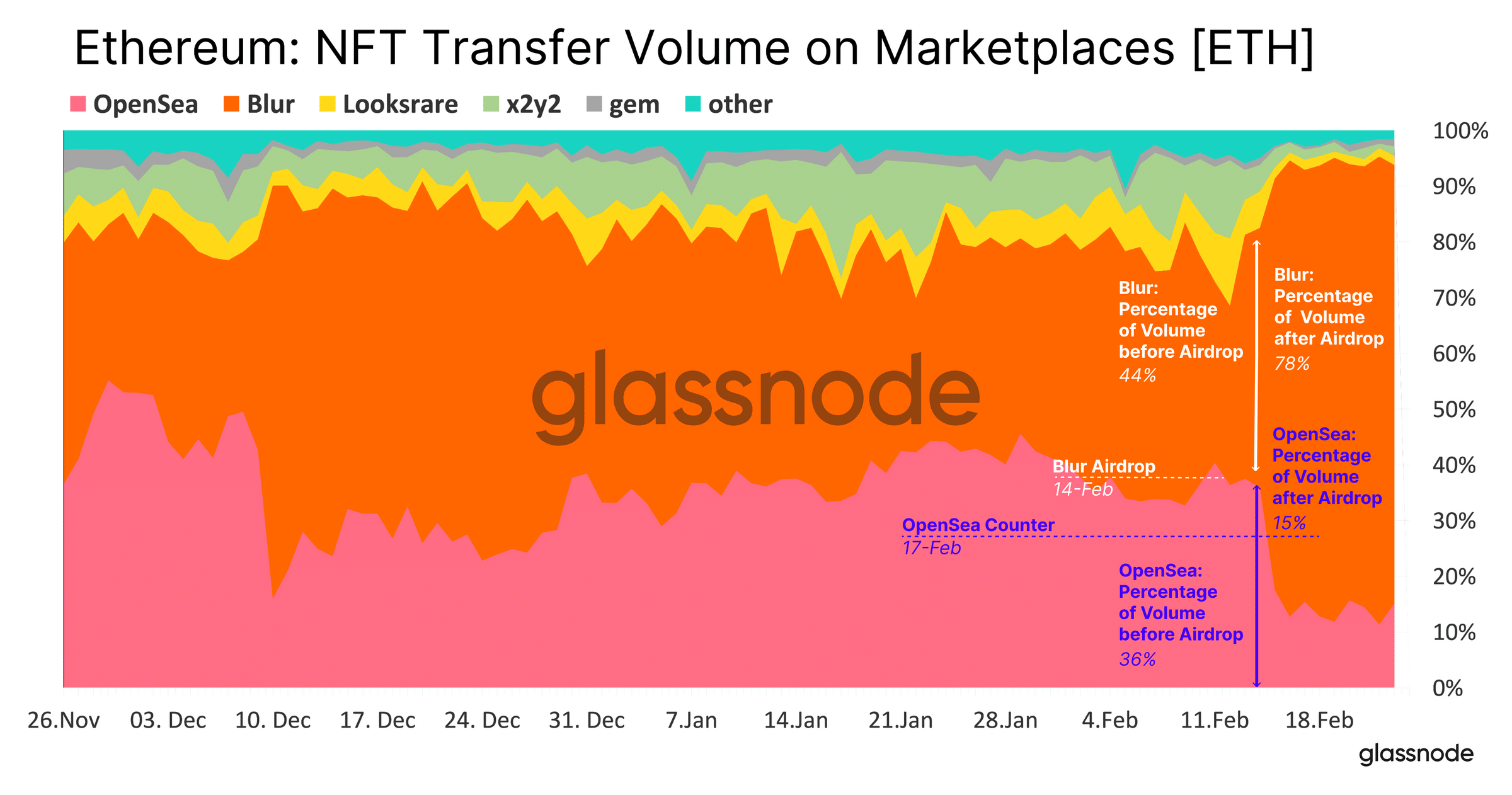
- Blur’s NFT transfer volume has actually crossed OpenSea.
- The variety of brand-new addresses on Ethereum is still low.
Considering that its launch in October 2022, Blur [BLUR] has actually gotten considerable traction, surpassing market leader OpenSea in NFT transfer volume, Glassnode found in a brand-new report.
How much are 1,10,100 BLURs worth today?
Blur marks considerable victories
According to the on-chain information company, the rise in Blur’s market share followed its token AirDrop on 14 February. Prior to the BLUR token AirDrop, the NFT market and aggregator held 48% of the NFT transfer volume in the whole market. {Nevertheless, following the AirDrop, its NFT transfer volume leapt to a high of 78%.
This substantially impacted OpenSea as its NFT transfer volume come by 21% following BLUR’s AirDrop.

Source: Glassnode
Glassnode specified that Blur’s success within a couple of months of its launch was because of its nature as an expert trading platform for NFTs, which includes a zero-trading cost design and optional royalty payments.|Following the AirDrop, its NFT transfer volume leapt to a high of 78%.
This substantially impacted OpenSea as its NFT transfer volume dropped by 21% following BLUR’s AirDrop.
Source: Glassnode
Glassnode specified that Blur’s success within a couple of months of its launch was due to its nature as an expert trading platform for NFTs, which includes a zero-trading cost design and optional royalty payments.}
In addition, following the BLUR token AirDrop, the platform carried out a token benefit system that incentivizes users to publish quotes. This has actually boosted market depth and increased NFT sales frequency, causing enhanced liquidity and trading experiences.
OpenSea tried to counter Blur’s success by reorganizing its cost design and policies, however this had a minimal effect as the platforms have various user bases.
We’re making some huge modifications today:1) OpenSea cost → 0% for a minimal timeFebruary 17, 2023
2) Relocating to optional developer revenues (0.5% minutes) for all collections without on-chain enforcement (old & & brand-new)

3) Marketplaces with the very same policies will not be obstructed by the operator filter
— OpenSea (@opensea)

Moreover, Blur’s day-to-day sales frequency per distinct user is substantially greater than OpenSea. This, according to Glassnode, develops “a flywheel impact,” with more sellers feeling great listing on Blur’s platform, developing a bigger offering that brings in more purchasers.
Source: Glassnode
Glassnode discovered even more that comparing the sale sizes of the 2 markets exposed that Blur’s method has actually developed a more profitable sales environment, as evidenced by sale quantities varying from 0.3 to 1.3 ETH. On the other hand, OpenSea has actually kept a constant average of roughly 0.2 ETH for numerous months.
Source: Glassnode
The Ethereum network is not the winner, after all
While Blur’s activity may have caused increased need in blockspace and validator costs on Ethereum, contrary to the belief held by numerous, there has actually been no considerable effect on network adoption, Glassnode discovered.

While there has actually been a development in on-chain activity, the variety of brand-new addresses is still 40% lower than this time in 2015, showing unfavorable momentum.